Now ask yourself, when was the last time you wrote both a capital AND a cursive Q!?!? Or even more mind blowing, a Z? The instances for those letters in my handwritten letters or on a check are never, so I didn't even remember the funny way they look...or how hard it was for me to learn how to write the Q. The capital cursive Q (doesn't that sound like a good band name or book title?) is almost like a crazy mixed up number 2. During one of my classes, a professor had written in cursive, on a board no less, and a Q appeared twice! (That's what you get for being in a stats based class - qualitative and quantitative) Seeing it up there in all its squiggly glory brought back memories. Remember the handy lined paper that was used to learn letter writing, both cursive and print?
Exhibit A -
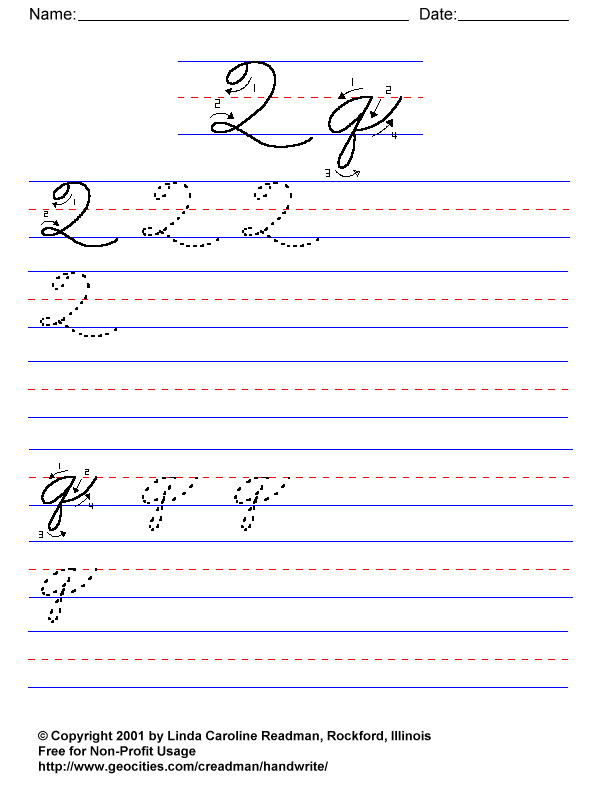
Sadly, the art of cursive is dying out, being replaced with forms of "non-writing" such as emails, texts, IMs, and probably newer things I've never heard of. Children no longer have to fear mastering the cursive Q or Z. Parents in some articles I've read make it sound like a method of torture to teach cursive writing...puh-LEASE!
Here's to a dying art...


I remember looking at the cursive diagrams in elementary school and so badly wanting my first name to start with Q.
ReplyDeletecursive rocks! I find myself mixing print and cursive together when I write. I hope we don't lose the art of writing cursive! That would be absolutely ridiculous.
ReplyDeletePersaonlly, I am a huge fan of the cursive uppercase Q. Part of that may come from being a second grade teacher (the cursive year) and from helping my girlie learn her cursive.
ReplyDeleteCursive is so much simpler and faster to write with than manuscript. The problem is it is only more simple if you practice as a kid. A lot.
My girlie's school teaches cursive but then doesn't require them to write with the method in other subject areas. If she was requirede to use cursive more then it would become more automatic.
Long live Q!
I have used cursive most of my life, the Q,F&Z was always my favorites to write.
ReplyDeleteI don't really understand why people want to move away from the writing style. One cannot always take a laptop into class, and it often takes way to long to print out the notes if the teacher is moving fast.
Not to mention the need to be able to sign your name on legal documents.
That and it looks cool!
Time magazine article about this topic
ReplyDeletehttp://www.time.com/time/magazine/article/0,9171,1912419-2,00.html
When I was just learning cursive at age 6, I remember thinking it looked like a fancily written 2. 7 years later, I had to look up this site to figure out how to write it... :(
ReplyDeleteCursive is awesome! However, I use it everywhere, to the point where I cannot write legible manuscript anymore. :(
ReplyDeleteI blame misguided cursive instruction for my bad handwriting today. Kids should be taught to letter, not to write in script. Nothing like having to fill C size sheets with quarter inch block capitals until you get it right in technical drawing, just because your teachers did not believe in straight lines when you were little.
ReplyDeleteI do all my writing in cursive, it doesnt take as long to write things out, but it is genrally harder to read so I dont worry about people snooping over my shoulder to see that I am writing. sadly it is becoming a lost art....is it even taught?
ReplyDeleteMan! I only use cursive! My great grandmother always wrote in cursive, so it tore me up that I couldn't read her letters as a small child (Circa kindergarten) so in 2nd grade when I saw my teacher write in cursive (accidentally) and erase it, I had her spend extra time helping me learn how, a year EARLY!
ReplyDeleteA lot of people, lately, have been making a lot of noise about the death of cursive handwriting. They don't want cursive to die. Handwriting matters ... But does cursive matter?
ReplyDeleteResearch shows that the fastest and most legible handwriters avoid cursive. They join only some letters, not all of them: making the easiest joins, skipping the rest, and using print-like shapes for those letters whose cursive and printed shapes disagree. (Citation: Steve Graham, Virginia Berninger, and Naomi Weintraub. THE RELATIONSHIP BETWEEN HANDWRITING STYLE AND SPEED AND LEGIBILITY. 2001: on-line at http://www.sbac.edu/~werned/DATA/Brain%20research%20class/handwriting%20speed%20style%20legibility%20berninger.pdf )
What about _reading_ cursive? This matters vitally — it takes just 30 to 60 minutes to learn, and can be taught to a five- or six-year-old if the child knows how to read. The value of reading cursive is therefore no justification for writing it.
Why, then, the idolatry of cursive? Remember that research about the fastest, most legible handwriters? Most people who write that way were never taught to do it. Like the rest of us, they'd probably been taught otherwise. They had to stumble on those useful habits themselves, by consciously or unconsciously discarding what didn't work in the printing or cursive styles they'd been taught, and keeping the best components of what was left — which meant breaking some of the rules they had been taught.
But why leave it to chance and breaking the rules? There are books, web-sites, and (in the texting age) software designed to teach those better habits from the get-go and save handwriting for the twenty-first century. (Which ones? A letter like this is not the place for product reviews — though I welcome reader inquiries.)
Yours for better letters,
Kate Gladstone — CEO, Handwriting Repair/Handwriting That Works
Director, the World Handwriting Contest
Co-Designer, BETTER LETTERS handwriting trainer app for iPhone/iPad
http://www.HandwritingThatWorks.com
As a 23-year old graduate student, I was embarassed to admit to some foreign graduate students that I couldn't write in cursive. They were astonished, as it seems they learn to write English mainly in cursive. I recall learning cursive in grade school but did not find it comfortable to write in. I distinctly remember the glorious 4th grade, when we were no longer required to write in cursive- my print handwriting began to dominate quickly. Since that time, I've only written in print and even signed my name in such.
ReplyDeleteAfter the realization I couldn't write in cursive, I saw it as a challenge to learn how- not to take faster notes but in order to address thank-you notes in a ladylike handwriting. I think the cursive style should continue to be taught and cherished as a technique that can be fast or can be used in more formal settings. Great discussion.
This is my non-written non-comment :)
ReplyDeleteI hate cursive!!!
ReplyDeletehi
ReplyDeleteI, for one, am glad cursive is dying.
ReplyDeleteIt's a pain in the arse to read.
I can't imagine any teacher actually enjoying trying to read sloppy cursive writing.
But ironic it is, that I am now retraining myself in it for one purpose. The Stylus Pen for the Galaxy note 2. It's much more effective to take notes on that thing with cursive writing because of how it detects strokes.
Go figure.
I agree with the input from Chile that the uppercase cursive Q is funky, and also is rather nonsensical in that it bears no resemblance to a printed uppercase capital Q. I write my uppercase Q by taking an uppercase O and adding a small curved line at the bottom right. It really looks appropriate and anyone can ascertain which letter of the alphabet it represents.
ReplyDeleteCursive is useful for reading historical documents like the original Declaration of Independence or the Constitution of the United States of America
ReplyDelete
ReplyDeleteReading cursive matters, but even children can be taught to read writing that they are not taught to produce. Reading cursive can be taught in just 30 to 60 minutes — even to five- or six-year-olds, once they read ordinary print. Why not teach children to read cursive, along with teaching other vital skills, including a handwriting style typical of effective handwriters?
Background on our handwriting, past and present:
A BRIEF HISTORY OF CURSIVE —
http://youtu.be/3kmJc3BCu5g
TIPS TO FIX HANDWRITING —
http://youtu.be/s_F7FqCe6To
[AUTHOR BIO: Kate Gladstone is the founder of Handwriting Repair/Handwriting That Works and the director of the World Handwriting Contest]
Yours for better letters,
Kate Gladstone
Handwriting Repair/Handwriting That Works
and the World Handwriting Contest
http://www.HandwritingThatWorks.com